
Delimitation Bill in India: Constitution (132nd Amendment) 2026 – Landmark Change or Controversial
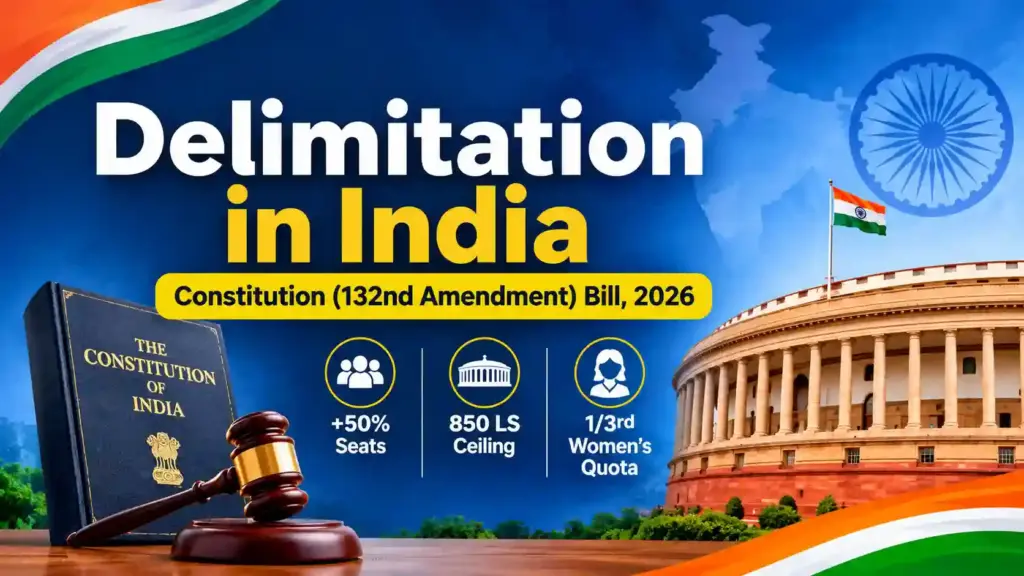
Table of Contents
Delimitation Bill 2026 – Ready for Parliament
| Parameter | Key Fact |
| Bill Name | Constitution (132nd Amendment) Bill, 2026 (New Delimitation Bill) |
| Status | Cleared by Union Cabinet; ready for Parliament |
| Session Type | Reconvened Monsoon Session (not a special session; previous session not prorogued) |
| Prorogation Authority | President on recommendation of the Council of Ministers |
| Parliament Schedule | Lok Sabha: 30 Nov | Rajya Sabha: 2 Dec | Expected end: 3 Dec |
| Census Basis | Latest available census (expected: 2011 Census, as delayed 2021 Census just started) |
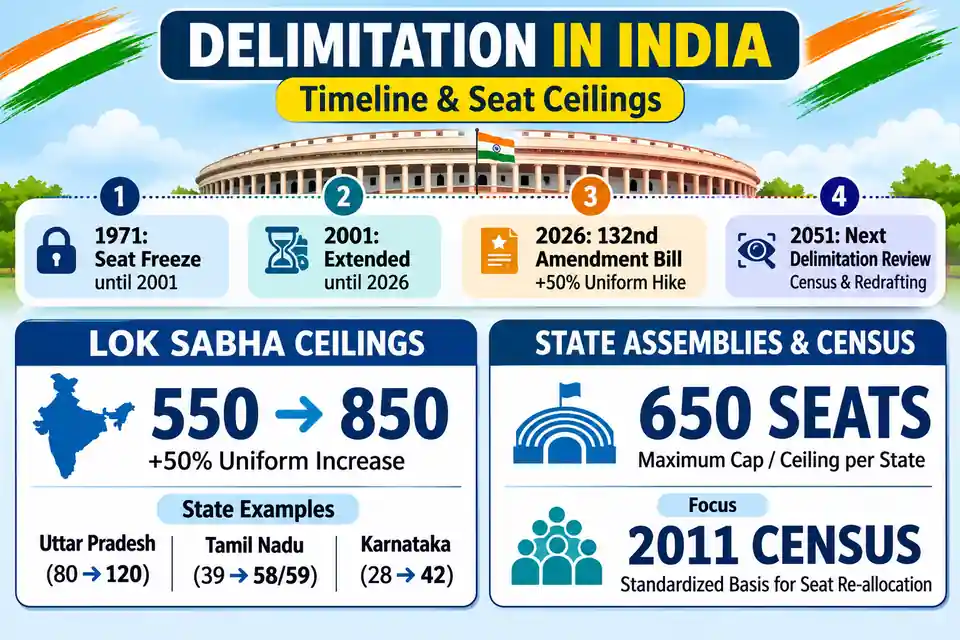
| Next Delimitation Freeze | Frozen until 2051 |
Historical Timeline of Delimitation in India
| Year | Delimitation Milestone | Government | Core Reason / Outcome |
| 1971 | Seat freeze until 2001 (42nd amendment act) | Indira Gandhi | Prevented Northern states (UP, Bihar) from dominating seats due to faster population growth |
| 2001 | Freeze extended until 2026 (84th amendment Act) | Atal Bihari Vajpayee | Maintained inter-state representation balance |
| April 2026 | Earlier Delimitation Bill failed | Current Govt. | Got simple majority; failed 2/3rd special majority requirement |
| Nov 2026 | 132nd Amendment Bill approved | Current Govt. | Uniform +50% formula addresses Southern states’ (TN, Karnataka) seat-share fears |
Seat Allocation & Ceilings Under Delimitation Bill 2026
| Category | Current Status | Proposed Under 2026 Delimitation |
| Formula | Frozen (1971 proportions) | +50% uniform increase per state (seat ratios unchanged) |
| Lok Sabha Ceiling | 550 (543 effective; 2 Anglo-Indian seats removed) | 850 (total crosses 800 after +50% hike) |
| State Assembly Ceiling | 500 (Article 170) | 650 max per state |
| *Uttar Pradesh (LS) | 80 seats | 120 seats |
| *Tamil Nadu (LS) | 39 seats | 58–59 seats |
| *Karnataka (LS) | 28 seats | 42 seats |
*Note – UP, Tamil Nādu, Karnataka Lok Sabha proposed seats are shown here just as example. Real allocated seats will be determined after the final bill.
Article 170 – A state legislative assembly can have minimum seats 60 and maximum seats can be 500. Highest: UP (403 seats)
Why Delimitation Bill Expands Seats
| Driver | Current | After Delimitation |
| MP-to-Population Ratio | With the population increase, it is also expanding. | Smaller constituencies; better representation |
| Women’s Reservation (2023 Act) | Passed, pending delimitation exercise | 1/3rd (33%) seats reserved (LS, State Assemblies, Delhi, J&K, & within SC/ST quota) |
| Male MP Cushion | 543 seats → 1/3rd cut would displace incumbents | +50% expansion preserves male MP numbers |
| Target Rollout | Pending Presidential assent | 2029 Lok Sabha Elections |
Example – Delimitation & Rotational 1/3rd Women’s Reservation
| Election Cycle | Reserved for Women (6-Seat Example: A,B,C,D,E,F) | Open Seats | Key Rule / Impact |
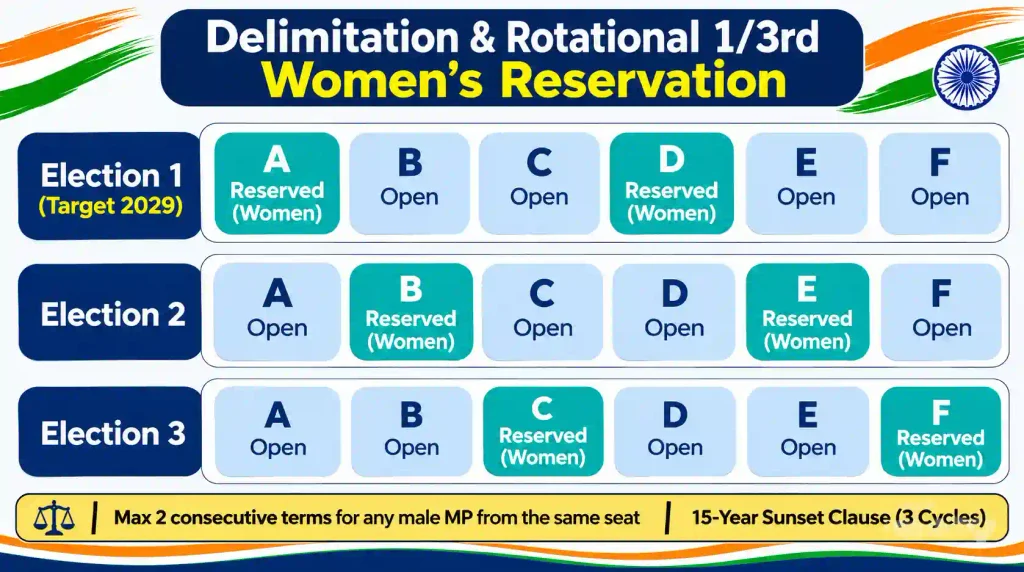
| Election 1 (Target 2029) | A, D | B, C, E, F | Rotational seat allocation begins |
| Election 2 | B, E | A, C, D, F | Every constituency gets a turn |
| Election 3 | C, F | A, B, D, E | Max 2 consecutive terms for any male MP from the same seat (e.g., Varanasi) |
| Duration (Sunset Clause) | 15 years (~3 Lok Sabha cycles) | — | Reviewed by Parliament after 15 years |
What is Delimitation Commission – Structure & Constitutional Powers
| Aspect | High-Yield Polity Detail |
| Body Type | Independent statutory body set up by Central Government and appointed by the President. |
| Chairperson | Serving or retired Supreme Court Judge |
| Other Members | Chief Election Commissioner (CEC) (or nominated EC) + respective State Election Commissioner(s) |
| Role Under 2026 Bill | Redraw constituency boundaries; identify SC/ST seats; fix women’s seat rotation (totals already fixed at +50%) |
| Legal Bindingness | Orders are final and legally binding |
| Judicial Bar | Article 329(a) bars courts from questioning delimitation laws or seat allotment |
FAQ
1. What is delimitation?
The defining and re-defining of constituencies for both Lok Sabha and State Assemblies, to ensure that each contains approximately equal numbers of people.
2. Why is delimitation undertaken?
As people’s population fluctuates over time, delimitation is used to maintain the ‘one person, one vote, one value’ ideal. It ensures that each constituency contains an equitable number of voters.
3. How is delimitation used to benefit SC/ST groups?
Delimitation determines which constituencies will be reserved for Scheduled Castes and Scheduled Tribes. This allows these groups to have appropriate political representation.
4. Which articles of the Constitution relate to delimitation?
Article 82 relates to Lok Sabha constituencies and Article 170 to State Legislative Assemblies. Parliament then creates a Delimitation Act following a census.
5. Who undertakes delimitation?
Parliament establishes an independent Delimitation Commission, which comprises three people.
Chairperson – either currently or previously serving Supreme Court Judge.
Chief Election Commissioner (or a nominated Election Commissioner).
State Election Commissioners – from the relevant states.
6. How many times has a Delimitation Commission been created?
Four times between 1952 and March 2026 – 1952, 1963, 1973 and 2002.
7. Can a delimitation order be contested in court?
Usually not. Article 329(a) prevents courts from challenging delimitation decisions. However, in the Kishor Chandra Chhanganlal Rathod decision (2024), the Supreme Court ruled that where a delimitation order is patently arbitrary or breaches constitutional values it can be subject to restricted judicial scrutiny.
8. Why were Lok Sabha seats frozen?
The 42nd Amendment Act, 1976 fixed the total number of Lok Sabha seats according to the 1971 Census figures. This ensured that states which had good population management (predominantly in South India) would not suffer from a reduction in the number of seats allocated to them.
9. Until when is the Lok Sabha seat freeze enforced?
The 84th Amendment Act, 2001 extended this until the first census taken after 2026.
📩 Subscribe to our Newsletter
Get new job alerts, results and admit card updates straight in your email.